Now Reading:

What do they do?

Font Selector
Sans Serif
Serif
Font Size
A
A
You can change the font size of the content.
Share Page

Exploring Dutch Heritage Through Research 
Exploring Dutch Heritage Through Research 

What do they do?

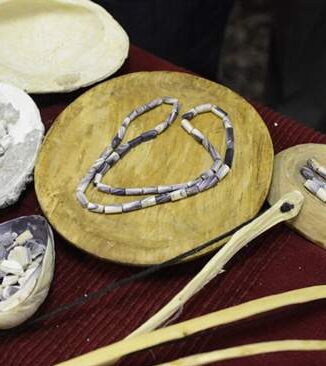
Participants in the 2012 summer institute were treated to a wampum-making demonstration by artist, writer, and re-enactor Arthur Kirmss. Known more commonly to the Dutch as sewant, these tubular shell beads were highly valued by Indians and served as a key medium of exchange in the fur trade. Along with beaver pelts, wampum also served as currency among Dutch settlers. Today Kirmss crafts wampum using 17th-century techniques and replica tools. Pictured are the shells from which he crafts the beads, grinding and polishing the broken bits of shell and drilling a hole through the center for storage and transportation. Photo by Dietrich Gehring

Many of the people who lived in New Netherland were involved in the fur trade with the Indians, particularly the Mohawks. Beaver pelts and other skins were shipped across the Atlantic Ocean to make felt hats and fur coats for Europeans. But not all colonists were traders, and many traders did other work. Most were farmers; others were bakers, shipbuilders, millers, shopkeepers, tailors, brewers, butchers, carpenters, wheelwrights, blacksmiths, coopers, and school teachers. But almost everyone traded in furs.

The colonists of New Netherland rarely used coins to buy goods and services. Instead they paid with furs or with shell beads, called wampum or sewant. These beads also served a ceremonial and decorative function among Indians.

WHAT WAS NEW NETHERLAND?


About New Netherland Institute

For over three decades, NNI has helped cast light on America's Dutch roots. In 2010, it partnered with the New York State Office of Cultural Education to establish the New Netherland Research Center, with matching funds from the State of the Netherlands. NNI is registered as a 501(c)(3) non-profit organization. Contributions are tax-deductible to the extent permitted by law.